You’ve successfully moved prospects through your entire funnel.
They’ve gone from strangers to visitors to engaged shoppers, selected products, and even initiated checkout. All that momentum – and all the marketing investment behind it – evaporates the instant they abandon their cart instead of completing purchase.
In 2025, with customer acquisition costs climbing across every channel and marketing budgets under scrutiny, cart abandonment isn’t just about lost sales anymore. It’s about understanding the true cost of customer acquisition and recognizing that every abandoned cart inflates your CAC while deflating your marketing ROI.
The businesses that master abandoned cart recovery are fundamentally improving their unit economics and making every marketing dollar work harder.
How to calculate true customer acquisition cost with cart abandonment?
What is CAC in eCommerce?
Customer Acquisition Cost (CAC) is the total amount of money you spend to get one new paying customer.
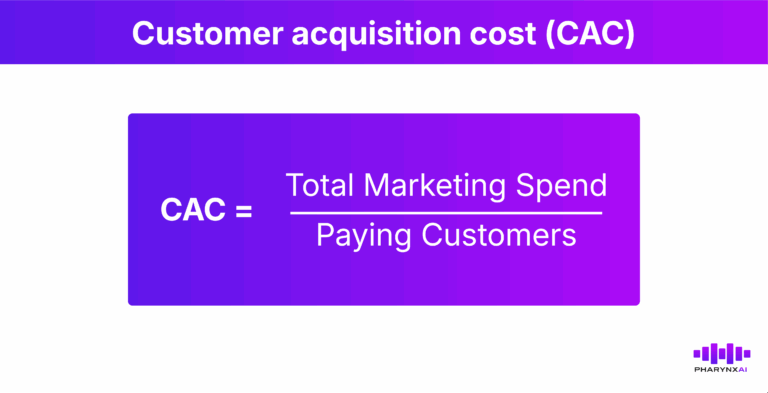
However, the reality is, your ad spend goes toward everyone who showed interest, and not just the ones who followed through and made a purchase.
Let’s walk through a real example that hits a little too close to home for most marketing teams.
- Campaign budget: $600
- Site visitors: 1,000 (hey, not bad!)
- Add to cart: 300 (getting warmer…)
- Initiate checkout: 150 (so close you can taste it)
- Complete purchase: 40 (Not quite the result you were hoping for!)
So, what actually went wrong?
Actual CAC: $600 ÷ 40 = $15 per customer
Imaginary CAC (if everyone who initiated checkout converted): $600 ÷ 150 = $4
That’s nearly 4x efficiency lost, just because people dropped off right at the finish line.
It’s like training for a marathon, running 41.5 kilometers, and then deciding to nap 300 meters from the end.
Where your customer acquisition budget actually goes:
- Advertising across Meta, Google (because apparently one platform isn’t enough)
- Retargeting campaigns (a.k.a. “please come back, we miss you” ads)
- Email and SMS systems that sound increasingly desperate
- Content marketing (those blog posts don’t write themselves)
- The tears and late nights of your team optimizing funnel performance
Without accurate tracking at every stage, your CAC calculations are incomplete, exposing your marketing investments to significant inefficiencies and budget waste.
What is the reason your CAC keeps increasing?
Today’s customers don’t follow a nice, neat path from “I need shoes” to “Here’s my credit card.” Because, let’s be honest, it isn’t that easy!
Instead, they go on a digital odyssey that would make Odysseus himself dizzy.
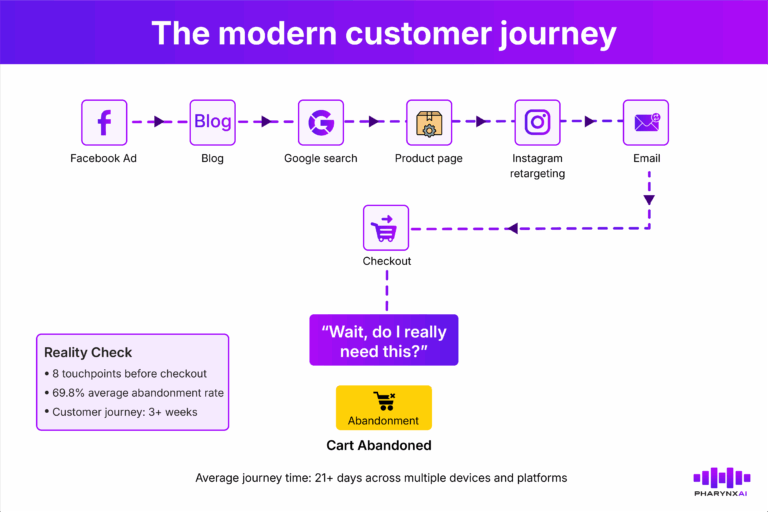
Think of it like dating with lots of interactions, but no guaranteed commitment!
At every stage:
- Platforms charge you
- Attribution gets complicated and hard to track
- People drop off faster than you’d expect
Even if someone interacts with your brand multiple times, a click here or a scroll there, they might still walk away before making a purchase. And by then, you’ve already paid to get their attention at every step.
What are the hidden costs behind every abandoned cart?
Most brands calculate CAC based on paying customers, but what about the ones who drop off right before purchasing?
Each abandoned cart carries hidden costs that quietly inflate your acquisition spend.
For this, full-funnel attribution helps you understand the entire customer journey, not just the final action before a purchase.
Here’s an example to help you understand better:
Stage | Channel | Role / Purpose | Cost Per Visitor |
Awareness | Facebook Ad | Introduces your brand to new people who might not know you yet | $1.50 |
Consideration | Blog Content | Provides helpful info to educate and build trust without any direct cost | $0 |
Intent | Google Search Ads | Captures people actively searching for what you offer, showing purchase intent | $2.00 |
Reminder | Instagram Retargeting | Re-engages visitors who showed interest but didn’t buy, keeping your brand top of mind | $1.00 |
Final Nudge | Email Campaign | Sends personalized offers or reminders to encourage those close to purchasing | $0.25 |
Total Cost Per Visitor: ~ $4.75
When someone abandons their cart, you lose approx. $4.75 in acquisition costs per person.
Multiply that by hundreds of abandoned carts, and suddenly your CAC looks like a phone number!
Why traditional cart recovery methods aren’t enough to increase CAC?
Most teams rely on email, SMS, and retargeting to recover abandoned carts because they’re inexpensive and easy to automate. These channels still have utility, especially when campaigns are well-segmented and tied to behavioral signals.
But their effectiveness has plateaued.
The core issue is that these channels work too late. Abandonment typically happens when the user is still in an active decision state. If the response comes hours later, or worse, the next day, the intent has already cooled. The user has likely moved on, been distracted, or made the purchase elsewhere.
This is where most recovery strategies lose efficiency. Brands pay to acquire traffic, nurture it through the funnel, and bring the user to the point of purchase, and then rely on delayed, low-attention channels to try and recover that value.
That short window between abandonment and disengagement is often where most of the loss happens, and where most traditional tools underperform.
Voice-based AI recovery solves it by being immediate.
When deployed within minutes of abandonment, it engages users while they’re still considering the purchase and does so in a medium that captures attention more effectively than another notification.
Abandoned cart recovery: Email vs SMS vs AI voice calls comparison
Factor | SMS | AI Voice Calls | |
Engagement Rate | Moderate (often low open & click rates) | High open rate, but low response rate | High engagement — feels more direct and personal |
Timing | Often delayed or scheduled | Immediate delivery | Real-time, triggered instantly after cart abandonment |
Tone & Personalization | Text-based, can feel generic | Short, often templated | Conversational, tailored to cart contents and user behaviour |
User Experience | Easy to ignore or overlook | Easy to ignore or overlook | Feels human-like, interactive, and timely |
Scalability | Highly scalable | Highly scalable | Scales well with AI — no limits on working hours |
Cost | Low cost per message | Slightly higher per message | Transparent per-call pricing — higher, but more impact |
Platform Dependency | Relies on email platforms | Requires SMS gateway or provider | Can operate independently from ad or messaging platforms |
Regulatory Sensitivity | Lower (if opted-in) | Higher (DND regulations, timing rules) | Requires consent but typically more compliant with timing |
Best Use Case | Newsletters, offers, low-priority follow-ups | Time-sensitive alerts, short messages | High-intent recovery, real-time support, deeper engagement |
AI voice calls for abandoned cart recovery
Agentic AI voice calling uses artificial intelligence to make personalized phone calls to customers who’ve abandoned their carts.
Think of it as a smart, tireless sales assistant who can manage thousands of conversations simultaneously, but with a key difference: it adapts based on who the customer is and what their situation looks like.
Now, not all abandoned carts are the same.
Some customers abandon because they’re comparing prices, others because they forgot or got distracted, and some are waiting for a better deal. To understand why this happens, explore the psychology behind cart abandonment in D2C e-commerce.”
Now, AI voice calls can be tailored to these different segments by adjusting tone, urgency, and messaging. For example, a high-value cart might trigger a more reassuring, consultative conversation, while a price-sensitive segment might hear an offer about payment plans or upcoming discounts.
Here’s why AI voice calls work better than traditional channels:
- Human voice > robot text: People connect better when they hear a real person speaking. A friendly voice feels more genuine and easier to relate to than automated messages.
- Real-time follow-up : Calls happen shortly after abandonment, when the customer’s intent is still fresh, increasing the chances of conversion.
- Scalable support: AI handles high call volumes any time of day, easing the burden on marketing teams.
- Transparent costs: Clear pricing without hidden fees makes budgeting easier.
By combining speed, personalization, and segmentation, AI voice calls create a smarter and more effective way to recover abandoned carts.
How to lower your customer acquisition cost?
Abandoned carts push up your customer acquisition costs and make your marketing look less effective than it actually is.
If you don’t have proper attribution in place, it’s hard to tell what’s working and what’s not. You’re basically guessing where to put your budget.
And while traditional recovery methods are familiar, they often end up costing more than the revenue they bring in, which means you’re spending money without seeing much return.
Agentic AI voice calls offer immediate, personalized, cost-effective outreach.
Instead of hoping someone sees your email among the 47 something other “abandoned cart” messages in their inbox, you’re having a real conversation at the moment their interest peaks.
If you’re serious about lowering your CAC and getting real attribution clarity, it’s time to stop throwing good money after bad on another retargeting campaign.
Sometimes the most innovative solution is also the most human one.. even when it’s powered by AI!
Remember! The goal isn’t just to recover abandoned carts. It’s to turn your leaky acquisition funnel into a well-oiled conversion machine.
And sometimes, the best way forward is to pick up the phone and actually talk to your customers.
Closing the loop
When your CAC feels higher than it should, the problem often isn’t how you attract people.. it’s what action you take after they show intent.
The biggest drop-offs usually happen right at the finish line. People are ready to buy, but the follow-up is too slow, or too easy to ignore. Most recovery tools aren’t built to respond quickly enough in that moment.
Addressing those moments quickly with AI voice calls helps improve both conversions and the efficiency of your acquisition efforts.
Less wasted spend, more conversions, better ROI.
It’s that simple.